

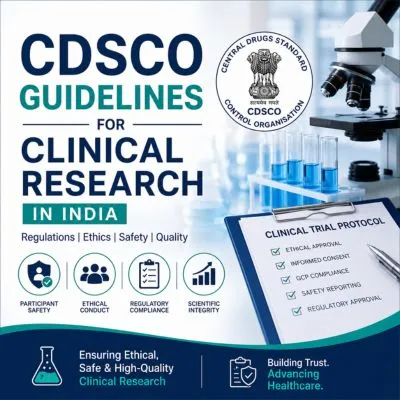
Central Drugs Standard Control Organization (CDSCO) serves as the primary regulatory authority for pharmaceuticals, medical devices, and clinical trials in India. Operating under the Ministry of Health and Family Welfare, CDSCO ensures that clinical research conducted in the country adheres to strict standards of safety, ethics, and scientific validity.
Clinical research plays a vital role in the development of new drugs, vaccines, and medical technologies. However, because it involves human participants, it must be governed by well-defined rules to safeguard their rights and well-being. In India, CDSCO has established a robust regulatory framework that not only protects participants but also promotes innovation and global collaboration.
The introduction of the New Drugs and Clinical Trials Rules, 2019 marked a significant step toward modernizing clinical research regulations in India. These rules provide clarity, streamline approval timelines, and align Indian practices with international standards.
Regulatory Framework Governing Clinical Research
Clinical research in India is governed by a combination of legal provisions, regulatory rules, and ethical guidelines. CDSCO acts as the central authority responsible for implementing these regulations.
The New Drugs and Clinical Trials Rules, 2019 (NDCTR) form the backbone of the current regulatory structure. These rules define procedures for clinical trial approvals, responsibilities of stakeholders, and requirements for safety monitoring.
In addition to NDCTR, the Drugs and Cosmetics Act, 1940 provides the legal foundation for drug regulation in India. Ethical oversight is further strengthened by guidelines issued by the Indian Council of Medical Research (ICMR), which focus on the protection of human participants.
Together, these frameworks ensure that clinical trials in India are conducted in a transparent, accountable, and scientifically sound manner.
Key Principles of CDSCO Guidelines
1. Protection of Human Participants
The most important principle of CDSCO guidelines is the protection of trial participants. Every clinical trial must prioritize the safety, rights, and dignity of individuals involved. Researchers must ensure that risks are minimized and justified by potential benefits.
2. Ethical Review and Approval
Before any clinical trial begins, it must be reviewed and approved by a CDSCO-registered Ethics Committee. This committee evaluates the study protocol, consent process, and risk-benefit ratio to ensure ethical compliance.
3. Scientific Validity
Clinical trials must be designed using sound scientific methods. This includes proper study design, appropriate sample size, and clearly defined endpoints. Poorly designed studies are not approved, as they may expose participants to unnecessary risks without generating useful data.
4. Informed Consent
Obtaining informed consent is a mandatory requirement. Participants must be provided with complete information about the study, including its purpose, procedures, potential risks, and benefits. Consent must be given voluntarily and documented properly.
5. Regulatory Approval
Sponsors must obtain prior approval from CDSCO before initiating a clinical trial. This ensures that only well-evaluated and justified studies are conducted in the country.
Types and Phases of Clinical Trials in India
Clinical trials are conducted in different phases to evaluate the safety, effectiveness, and overall performance of a new drug or medical product. Under the supervision of Central Drugs Standard Control Organization, each phase serves a specific purpose and follows strict regulatory and ethical standards.
Phase I – Safety and Dosage
This is the first stage of testing in humans and usually involves a small group of healthy volunteers. The primary objective is to assess the safety of the drug, determine safe dosage ranges, and identify potential side effects. Researchers closely monitor how the drug behaves in the human body.
Phase II – Efficacy and Side Effects
In this phase, the drug is administered to a larger group of participants who have the condition the drug is intended to treat. The goal is to evaluate the drug’s effectiveness and further assess its safety. Data collected during this phase helps determine whether the drug shows promising results.
Phase III – Confirmation and Comparison
Phase III trials involve a much larger population and are conducted across multiple locations. These studies compare the new drug with existing treatments or placebos to confirm its effectiveness, monitor adverse reactions, and collect comprehensive data for regulatory approval.
Phase IV – Post-Marketing Surveillance
After the drug receives approval and enters the market, Phase IV studies are conducted to monitor its long-term safety and effectiveness in the general population. This phase helps identify rare or long-term side effects that not have been evident during earlier trials.
Types of Clinical Trials
Apart from phases, clinical trials can also be categorized based on their purpose:
- Interventional Trials – Participants receive specific treatments or interventions to evaluate outcomes.
- Observational Studies – Researchers observe participants without assigning any treatment.
- Bioavailability and Bioequivalence Studies (BA/BE) – These studies compare how different formulations of a drug perform in the body.
- Investigator-Initiated Trials – Conducted by individual researchers or institutions rather than pharmaceutical companies.
Roles and Responsibilities of Stakeholders
Sponsor
The sponsor is responsible for initiating, funding, and managing the clinical trial. They ensure compliance with regulatory requirements and oversee the overall study.
Investigator
The investigator conducts the clinical trial at the site level. They are responsible for participant safety, protocol adherence, and accurate data collection.
Ethics Committee
Ethics Committees play a critical role in protecting participants. They review study protocols, monitor ongoing trials, and ensure ethical standards are maintained.
CDSCO
CDSCO acts as the regulatory authority overseeing all aspects of clinical research. It grants approvals, conducts inspections, and enforces compliance.
Good Clinical Practice (GCP) Compliance
Good Clinical Practice (GCP) is an essential component of CDSCO guidelines. GCP provides a set of internationally accepted standards for designing, conducting, and reporting clinical trials.
Compliance with GCP ensures that:
- The rights and safety of participants are protected
- Data generated is reliable and credible
- Trials are conducted in an ethical and transparent manner
Adherence to GCP also enhances the global acceptance of clinical data generated in India.
Safety Reporting and Compensation Mechanism
CDSCO has established strict rules for safety reporting and participant compensation.
Adverse Event Reporting
All serious adverse events (SAEs) must be reported within specified timelines. This allows authorities to take timely action if safety concerns arise.
Medical Management
Participants must receive free medical care for any trial-related injury during the study period. This ensures their well-being is not compromised.
Recent Developments and Reforms
The implementation of NDCTR 2019 has brought several improvements to the clinical research ecosystem in India. These include:
- Defined timelines for approval of clinical trials
- Simplified regulatory procedures
- Enhanced transparency in the approval process
- Provisions for accelerated approval of critical drugs
- Improved digital systems for application submission and tracking
These reforms have made India an attractive destination for global clinical research while maintaining strict regulatory oversight.
Challenges in Clinical Research Regulation
Despite significant progress, certain challenges remain in the clinical research landscape:
- Ensuring uniform implementation of guidelines across regions
- Increasing awareness among stakeholders
- Maintaining a balance between innovation and regulation
- Strengthening infrastructure for clinical trial monitoring
Addressing these challenges is essential for further growth and development of the sector.
Conclusion
CDSCO guidelines for clinical research provide a comprehensive framework that ensures ethical conduct, participant safety, and scientific integrity. With the introduction of modern regulations like the New Drugs and Clinical Trials Rules, 2019, India has strengthened its position in the global clinical research arena.
For sponsors, investigators, and organizations, understanding and complying with CDSCO guidelines is crucial for successful clinical trial execution. By adhering to these regulations, stakeholders can contribute to the development of safe and effective medical innovations while maintaining the highest standards of ethics and quality.
To learn more about Central Drugs Standard Organization (CDSCO) in Haryana, Gujarat, Maharashtra and Uttar Pradesh we recommend you to visit Metacorp as it solve legal and compliance issues of new and established businesses.